






Few games have achieved the quiet, meditative impact of Monument Valley, developed by ustwo games. At first glance, it appears to be a minimalist puzzle experience built around optical illusions and elegant level design. However, beneath its calm aesthetic lies a deeply intentional system where architecture itself becomes storytelling.

This article explores a specific and central theme: the use of impossible geometry as a narrative language. Rather than treating the game’s shifting structures as mere puzzles, Monument Valley uses spatial manipulation to express themes of guilt, transformation, forgiveness, and perception. Across ten chronological and thematic stages, we examine how the game gradually evolves its architectural language from simple illusions to emotionally resonant structures that redefine how players interpret space.
The Silent Beginning: Geometry Without Explanation
A World Defined by Structure
The opening moments of Monument Valley introduce players to a world where architecture exists without context. There is no exposition, no explanation—only structures floating in silence. The protagonist, Ida, moves through spaces that appear stable but reveal their instability through interaction.
This lack of narrative framing places emphasis on perception. Players are not told how the world works; they must learn by observing how geometry behaves.
The First Illusion as Language
The earliest puzzles rely on simple perspective shifts. A path that appears broken suddenly connects when viewed from a specific angle. These moments establish the core mechanic:
- Reality is dependent on viewpoint
- Structure is not fixed
- Perception defines possibility
These principles are not just gameplay mechanics—they are the foundation of the game’s narrative language.
The Introduction of the Impossible: Escher-Like Space
Defying Physical Logic
As the game progresses, structures begin to resemble the impossible constructions associated with artists like M. C. Escher. Staircases loop into themselves, towers rotate into new configurations, and paths exist where they logically should not.
These designs challenge the player’s understanding of space, forcing them to abandon real-world assumptions.
The Role of Visual Trust
Initially, players trust what they see. But as impossible geometry becomes more complex, that trust is broken. The game teaches players that visual consistency does not guarantee structural truth.
This creates a subtle psychological shift: players begin questioning not just the puzzles, but their own perception.
Architecture as Barrier and Guide
Structures That Restrict Movement
Many early levels use architecture as a barrier. Walls block paths, towers isolate sections, and bridges appear incomplete.
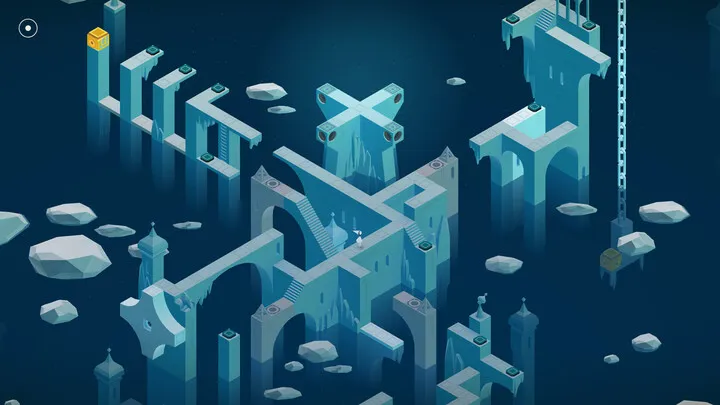
These obstacles are not static—they are designed to be manipulated through perspective.
Guiding Without Instruction
Despite the absence of explicit guidance, the game directs players through visual cues:
- Bright colors indicating interactable elements
- Symmetry suggesting possible alignment
- Movement hints embedded in structure
The architecture itself becomes a form of communication, guiding players without words.
The Emergence of Symbolic Structures
Geometry as Emotional Expression
Midway through the game, structures begin reflecting emotional states rather than just mechanical challenges. Towers appear fragmented, paths feel disjointed, and environments become more abstract.
These changes suggest that architecture is no longer neutral—it is expressive.
Recurring Motifs
Certain structural elements repeat throughout the game:
- Spiral staircases symbolizing progression
- Isolated platforms representing separation
- Rotating towers indicating change
These motifs build a visual language that players learn to interpret subconsciously.
The Totem: A Companion in Space
Introducing a Dynamic Element
The introduction of the Totem changes how players interact with geometry. Unlike static structures, the Totem moves and responds to player actions.
This adds a relational dimension to the environment.
Shared Navigation
With the Totem, puzzles become cooperative:
- Aligning paths for both characters
- Timing movements across shifting structures
- Creating connections through perspective
This dynamic reinforces the idea that space is not fixed—it is shared and adaptable.
The Breakdown of Spatial Consistency
Increasing Complexity
As the game approaches its later stages, spatial logic becomes increasingly unstable. Structures twist in ways that defy even the game’s established rules.

Paths appear and disappear unpredictably, and entire sections rotate into new forms.
The Loss of Orientation
Players begin losing their sense of direction. What once felt like a coherent space becomes fragmented.
This disorientation mirrors the narrative’s emotional depth, suggesting inner conflict and uncertainty.
Light, Color, and Perception
Visual Layers Beyond Structure
In later levels, light and color become as important as geometry. Shifting colors indicate changes in state, while lighting highlights possible paths.
These elements add another layer to perception.
Color as Meaning
Different colors often represent:
- Stability or instability
- Interactivity or passivity
- Progression or stagnation
The combination of color and structure creates a multi-dimensional visual language.
The Reconfiguration of Reality
Transforming Entire Environments
Certain levels allow players to rotate or shift entire structures, effectively redefining the environment.
This mechanic emphasizes that reality within the game is fluid.
Player as Architect
At this stage, players are no longer just navigating architecture—they are reshaping it.
This shift transforms the player’s role:
- From observer to participant
- From solver to creator
- From traveler to architect
The narrative becomes interactive at a deeper level.
The Final Structures: Simplicity and Resolution
Returning to Minimalism
In the final stages, the game returns to simpler structures. However, these spaces carry the weight of previous complexity.
The simplicity feels intentional, almost reflective.
Clarity Through Reduction
By reducing complexity, the game provides clarity. The player’s understanding of geometry is now complete, allowing them to navigate effortlessly.
This resolution mirrors the narrative’s emotional closure.
Architecture as Memory
Spaces That Reflect the Journey
Looking back, each structure in Monument Valley represents a stage in the player’s journey.
The progression from simple to complex and back to simple mirrors a cycle of learning and understanding.
Lasting Impressions
Even after the game ends, its architectural language remains memorable. Players recall not just the puzzles, but the feeling of navigating impossible spaces.
This lasting impact demonstrates the power of design as storytelling.
Conclusion
Monument Valley transforms architecture into a narrative medium, using impossible geometry to explore themes of perception, transformation, and emotional growth. Through carefully designed structures, the game teaches players to question their assumptions about space and reality.
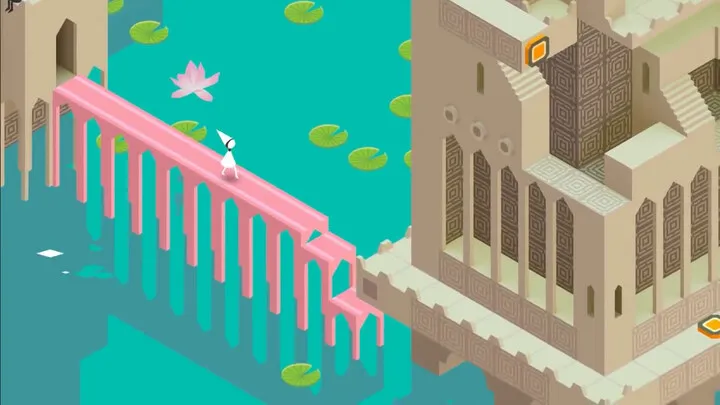
Rather than relying on dialogue or traditional storytelling, the game communicates entirely through design. Each level builds upon the last, creating a cohesive journey that is both intellectual and emotional.
By the end, players do not simply solve puzzles—they understand a language. A language where structure is meaning, perception is truth, and architecture tells a story that words never could.